
the idea is to input 3 CT slice into network. Red,green blue represents 3 CT slices
", "messages": [ { "id": 664775, "postDate": "2019-11-04T07:55:46.810Z", "content": "
the idea is to input 3 CT slice into network. Red,green blue represents 3 CT slices
", "rawMarkdown": "\n\n\nthe idea is to input 3 CT slice into network. Red,green blue represents 3 CT slices", "votes": 25 }, { "id": 665017, "postDate": "2019-11-04T14:35:55.797Z", "content": "
Another idea is to sample certain number of slices per study, stack them together then feed to a network. Think of sthg similar to video classification problems 😄.\nNevertheless, 2d models with tons of post-processing tricks can match with 3d models, at the cost of longer training.
", "rawMarkdown": "Another idea is to sample certain number of slices per study, stack them together then feed to a network. Think of sthg similar to video classification problems 😄.\nNevertheless, 2d models with tons of post-processing tricks can match with 3d models, at the cost of longer training.", "votes": 3, "replies": [ { "id": 665172, "postDate": "2019-11-04T17:35:22.550Z", "content": "That's true. A strong baseline of 2D models is essential.
", "rawMarkdown": "That's true. A strong baseline of 2D models is essential.", "votes": 1 }, { "id": 665193, "postDate": "2019-11-04T18:16:38.967Z", "content": "@andy2709 this sounds some thing new to me.. would be great if u can give some example ...
", "rawMarkdown": "@andy2709 this sounds some thing new to me.. would be great if u can give some example ..." }, { "id": 665468, "postDate": "2019-11-05T03:10:19.343Z", "content": "@shentao what each ct slice is here .\nDoes each slice is simply a different window view of ct image and then stacking those. ?
", "rawMarkdown": "@shentao what each ct slice is here .\nDoes each slice is simply a different window view of ct image and then stacking those. ?\n" } ] }, { "id": 666445, "postDate": "2019-11-06T05:27:05.137Z", "content": "Hi @hengck23, you are really awesome. I am just wondering if you can share your work (at least the visualization part) after the competition. Thank you in advance.
", "rawMarkdown": "Hi @hengck23, you are really awesome. I am just wondering if you can share your work (at least the visualization part) after the competition. Thank you in advance.", "votes": 1 }, { "id": 665029, "postDate": "2019-11-04T14:53:37.087Z", "content": "Those all seem a doppler ultrasound during examination. It´s only missing the sound from blood flow through arteries and veins. Great!
", "rawMarkdown": "Those all seem a doppler ultrasound during examination. It´s only missing the sound from blood flow through arteries and veins. Great!", "votes": 1 }, { "id": 665002, "postDate": "2019-11-04T14:13:55.847Z", "content": "Heng you're great both in your work and more like a human being, since I read two posts from people that you helped regretting the lost (solo gold). For us you're already gold. The other gold is just a matter of time.
", "rawMarkdown": "Heng you're great both in your work and more like a human being, since I read two posts from people that you helped regretting the lost (solo gold). For us you're already gold. The other gold is just a matter of time. ", "votes": 1 }, { "id": 665552, "postDate": "2019-11-05T05:28:38.780Z", "content": "it suddenly occurs to me that using mixup only with the nearby slices can improve results.
\n\nlet a,b, c be three consecutive slices. indeed the input and ouput label follows the linear rule: c= (a+b)/2
\n\nif so , it is also possible to apply match-mix semi-supervised learning, but the mixing must be dome at neighbor slices only.
\n\nmixup nearby slices is the same as making augmented interpolated sample in the z-direction
", "rawMarkdown": "it suddenly occurs to me that using mixup only with the nearby slices can improve results.\n\nlet a,b, c be three consecutive slices. indeed the input and ouput label follows the linear rule: c= (a+b)/2\n\n\n\n\nif so , it is also possible to apply match-mix semi-supervised learning, but the mixing must be dome at neighbor slices only.\n\n----\n\nmixup nearby slices is the same as making augmented interpolated sample in the z-direction", "votes": 2, "replies": [ { "id": 665561, "postDate": "2019-11-05T05:38:31.113Z", "content": "there are some other interesting approach i can think of, e.g.
\n\nlet a,b, c be three consecutive slices.
using train instances without Intracranial Hemorrhage, i.e. \"any\"label is 0, train a predictor such that\nnet (a,c) = b. we predict the center slice. this can be seen as a generator for negative instance train samples.
now assuming we have a test sample, let net(a,b)= b_predict. we have have another discriminator to see if net(b_truth , b_predict) = is same or not. if it is not the same, then we have abnormal detection
@hengck23 , Hello Heng, this is a very interestiong idea, but I have a question about the 3rd approach.\nIs b a test sample? If yes, according to 2, the generator is net (a,c) = b, the net(a,b)= b_predict should be net(a, c)= b_predict..., then, Let discriminator to see if net(b_truth , b_predict) = is same or not.
", "rawMarkdown": "@hengck23 , Hello Heng, this is a very interestiong idea, but I have a question about the 3rd approach.\nIs b a test sample? If yes, according to 2, the generator is net (a,c) = b, the net(a,b)= b\\_predict should be net(a, c)= b\\_predict..., then, Let discriminator to see if net(b\\_truth , b\\_predict) = is same or not." } ] }, { "id": 671975, "postDate": "2019-11-13T11:50:21.417Z", "content": "Hypnotizing!
", "rawMarkdown": "Hypnotizing!" }, { "id": 665440, "postDate": "2019-11-05T02:35:58.233Z", "content": "good one!
", "rawMarkdown": "good one!\n" }, { "id": 665136, "postDate": "2019-11-04T17:08:07.047Z", "content": "I have tried this method as well... I have not submitted predictions yet because I am still having trouble training on GCP with the full dataset, but I thought of an interesting TTA:
\n\nI also wanted to try an ensemble over models trained with multiple initial k = (3,5,7).\nyou seem closer to being able to train a model so I would love to hear what you think
", "rawMarkdown": "I have tried this method as well... I have not submitted predictions yet because I am still having trouble training on GCP with the full dataset, but I thought of an interesting TTA:\n\n- train a model to predict class of slice *n* given three slices *(n-k, n, n+k)* for some offset *k* \n- perform TTA by predicting on slices in the neigborhood of k, example if k=3 then predict on k=(2,3,4)\n- average prediction over the neighboorhood k\n\nI also wanted to try an ensemble over models trained with multiple initial k = (3,5,7).\nyou seem closer to being able to train a model so I would love to hear what you think", "replies": [ { "id": 665464, "postDate": "2019-11-05T03:07:37.420Z", "content": "@nikperi could u pls explain what slices r m still unable underetand this as shown above .\nWhat each slice of CT means .\nAll I though was we build windowed images of same image and stack them .
", "rawMarkdown": "@nikperi could u pls explain what slices r m still unable underetand this as shown above .\nWhat each slice of CT means .\nAll I though was we build windowed images of same image and stack them .\n\n" }, { "id": 666223, "postDate": "2019-11-05T22:40:37.513Z", "content": "The CT scan is a 3D scan composed of multiple stacks of 2D images. I refer to a slice as one of those 2D planes.
\n\nThis discussion demonstrated what the 3d reconstruction looks like
", "rawMarkdown": "The CT scan is a 3D scan composed of multiple stacks of 2D images. I refer to a slice as one of those 2D planes.\n\nThis [discussion]( https://www.kaggle.com/c/rsna-intracranial-hemorrhage-detection/discussion/109552#latest-631316) demonstrated what the 3d reconstruction looks like" } ] }, { "id": 665134, "postDate": "2019-11-04T17:07:02.567Z", "content": "It's cool, nice visualization and idea thank you for sharing
", "rawMarkdown": "It's cool, nice visualization and idea thank you for sharing" }, { "id": 665013, "postDate": "2019-11-04T14:27:20.533Z", "content": "@hengck23 amazing work..\nis above different from what you posted in earlier post\nWindowed slices of Brain,Subdural,Soft tissues and then dstack it to build 3 channel image
", "rawMarkdown": "@hengck23 amazing work..\nis above different from what you posted in earlier post\nWindowed slices of Brain,Subdural,Soft tissues and then dstack it to build 3 channel image" }, { "id": 664943, "postDate": "2019-11-04T12:48:19.050Z", "content": "Very cool
", "rawMarkdown": "Very cool" }, { "id": 664931, "postDate": "2019-11-04T12:20:00.220Z", "content": "I’m wondering how you come up with such a great idea.
", "rawMarkdown": "I’m wondering how you come up with such a great idea. " }, { "id": 664884, "postDate": "2019-11-04T10:49:54.557Z", "content": "Thanks a lot for all your information these years.\nI hope you could have the solo gold soon! XD!
", "rawMarkdown": "Thanks a lot for all your information these years.\nI hope you could have the solo gold soon! XD!" }, { "id": 664863, "postDate": "2019-11-04T10:15:25.920Z", "content": "Living on the edge, Heng CherKeng...
", "rawMarkdown": "Living on the edge, Heng CherKeng..." }, { "id": 664959, "postDate": "2019-11-04T13:19:26.273Z", "rawMarkdown": "", "isDeleted": true } ], "comments": [ { "id": 665017, "author_name": "hengck23", "author_url": "", "post_date": "2019-11-04T14:35:55.797000", "content": "
Another idea is to sample certain number of slices per study, stack them together then feed to a network. Think of sthg similar to video classification problems 😄.\nNevertheless, 2d models with tons of post-processing tricks can match with 3d models, at the cost of longer training.
", "votes": 3, "replies": [ { "id": 665172, "author_name": "SeuTao", "author_url": "", "post_date": "2019-11-04T17:35:22.550000", "content": "That's true. A strong baseline of 2D models is essential.
", "votes": 1, "replies": [] }, { "id": 665193, "author_name": "Jaideep", "author_url": "", "post_date": "2019-11-04T18:16:38.967000", "content": "@andy2709 this sounds some thing new to me.. would be great if u can give some example ...
", "votes": 0, "replies": [] }, { "id": 665468, "author_name": "Jaideep", "author_url": "", "post_date": "2019-11-05T03:10:19.343000", "content": "@shentao what each ct slice is here .\nDoes each slice is simply a different window view of ct image and then stacking those. ?
", "votes": 0, "replies": [] } ] }, { "id": 666445, "author_name": "Mohammad Azam Khan", "author_url": "", "post_date": "2019-11-06T05:27:05.137000", "content": "Hi @hengck23, you are really awesome. I am just wondering if you can share your work (at least the visualization part) after the competition. Thank you in advance.
", "votes": 1, "replies": [] }, { "id": 665029, "author_name": "Marília Prata", "author_url": "", "post_date": "2019-11-04T14:53:37.087000", "content": "Those all seem a doppler ultrasound during examination. It´s only missing the sound from blood flow through arteries and veins. Great!
", "votes": 1, "replies": [] }, { "id": 665002, "author_name": "Marília Prata", "author_url": "", "post_date": "2019-11-04T14:13:55.847000", "content": "Heng you're great both in your work and more like a human being, since I read two posts from people that you helped regretting the lost (solo gold). For us you're already gold. The other gold is just a matter of time.
", "votes": 1, "replies": [] }, { "id": 665552, "author_name": "hengck23", "author_url": "", "post_date": "2019-11-05T05:28:38.780000", "content": "it suddenly occurs to me that using mixup only with the nearby slices can improve results.
\n\nlet a,b, c be three consecutive slices. indeed the input and ouput label follows the linear rule: c= (a+b)/2
\n\nif so , it is also possible to apply match-mix semi-supervised learning, but the mixing must be dome at neighbor slices only.
\n\nmixup nearby slices is the same as making augmented interpolated sample in the z-direction
", "votes": 2, "replies": [ { "id": 665561, "author_name": "hengck23", "author_url": "", "post_date": "2019-11-05T05:38:31.113000", "content": "there are some other interesting approach i can think of, e.g.
\n\nlet a,b, c be three consecutive slices.
using train instances without Intracranial Hemorrhage, i.e. \"any\"label is 0, train a predictor such that\nnet (a,c) = b. we predict the center slice. this can be seen as a generator for negative instance train samples.
now assuming we have a test sample, let net(a,b)= b_predict. we have have another discriminator to see if net(b_truth , b_predict) = is same or not. if it is not the same, then we have abnormal detection
@hengck23 , Hello Heng, this is a very interestiong idea, but I have a question about the 3rd approach.\nIs b a test sample? If yes, according to 2, the generator is net (a,c) = b, the net(a,b)= b_predict should be net(a, c)= b_predict..., then, Let discriminator to see if net(b_truth , b_predict) = is same or not.
", "votes": 0, "replies": [] } ] }, { "id": 671975, "author_name": "Alex Tzimas", "author_url": "", "post_date": "2019-11-13T11:50:21.417000", "content": "Hypnotizing!
", "votes": 0, "replies": [] }, { "id": 665440, "author_name": "iffah", "author_url": "", "post_date": "2019-11-05T02:35:58.233000", "content": "good one!
", "votes": 0, "replies": [] }, { "id": 665136, "author_name": "Nikhil Peri", "author_url": "", "post_date": "2019-11-04T17:08:07.047000", "content": "I have tried this method as well... I have not submitted predictions yet because I am still having trouble training on GCP with the full dataset, but I thought of an interesting TTA:
\n\nI also wanted to try an ensemble over models trained with multiple initial k = (3,5,7).\nyou seem closer to being able to train a model so I would love to hear what you think
", "votes": 0, "replies": [ { "id": 665464, "author_name": "Jaideep", "author_url": "", "post_date": "2019-11-05T03:07:37.420000", "content": "@nikperi could u pls explain what slices r m still unable underetand this as shown above .\nWhat each slice of CT means .\nAll I though was we build windowed images of same image and stack them .
", "votes": 0, "replies": [] }, { "id": 666223, "author_name": "Nikhil Peri", "author_url": "", "post_date": "2019-11-05T22:40:37.513000", "content": "The CT scan is a 3D scan composed of multiple stacks of 2D images. I refer to a slice as one of those 2D planes.
\n\nThis discussion demonstrated what the 3d reconstruction looks like
", "votes": 0, "replies": [] } ] }, { "id": 665134, "author_name": "Soonhwan Kwon", "author_url": "", "post_date": "2019-11-04T17:07:02.567000", "content": "It's cool, nice visualization and idea thank you for sharing
", "votes": 0, "replies": [] }, { "id": 665013, "author_name": "Jaideep", "author_url": "", "post_date": "2019-11-04T14:27:20.533000", "content": "@hengck23 amazing work..\nis above different from what you posted in earlier post\nWindowed slices of Brain,Subdural,Soft tissues and then dstack it to build 3 channel image
", "votes": 0, "replies": [] }, { "id": 664943, "author_name": "Darragh", "author_url": "", "post_date": "2019-11-04T12:48:19.050000", "content": "Very cool
", "votes": 0, "replies": [] }, { "id": 664931, "author_name": "XY", "author_url": "", "post_date": "2019-11-04T12:20:00.220000", "content": "I’m wondering how you come up with such a great idea.
", "votes": 0, "replies": [] }, { "id": 664884, "author_name": "zlannn", "author_url": "", "post_date": "2019-11-04T10:49:54.557000", "content": "Thanks a lot for all your information these years.\nI hope you could have the solo gold soon! XD!
", "votes": 0, "replies": [] }, { "id": 664863, "author_name": "Andrés Miguel Torrubia Sáez", "author_url": "", "post_date": "2019-11-04T10:15:25.920000", "content": "Living on the edge, Heng CherKeng...
", "votes": 0, "replies": [] }, { "id": 664959, "author_name": "", "author_url": "", "post_date": "2019-11-04T13:19:26.273000", "content": "", "votes": 0, "replies": [] } ], "raw_markdown_by_id": { "664775": "\n\n\nthe idea is to input 3 CT slice into network. Red,green blue represents 3 CT slices", "665017": "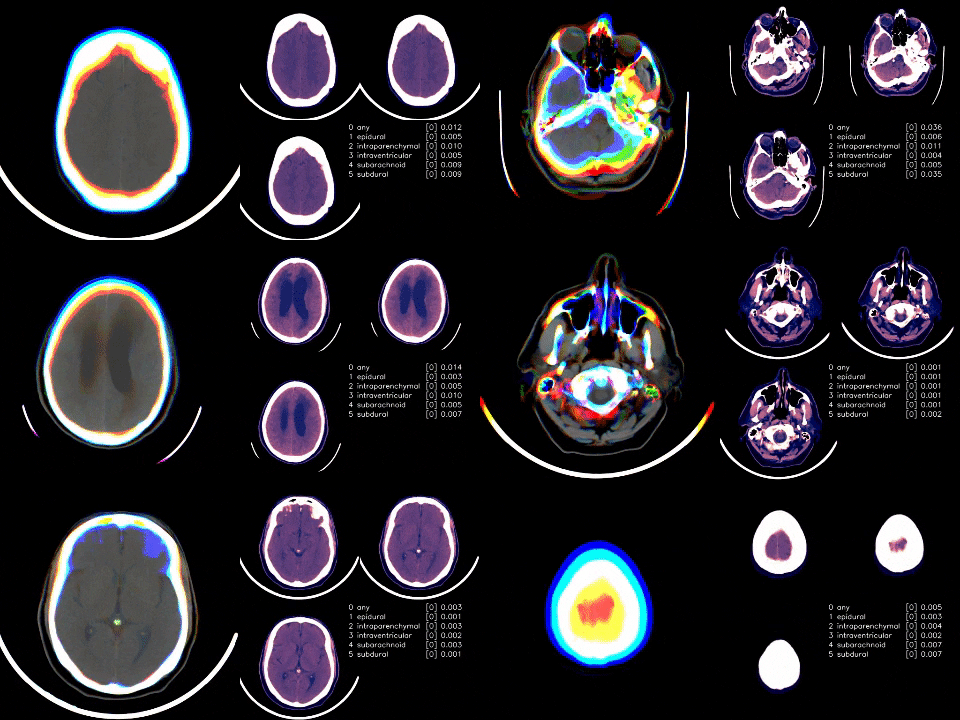", "665165": "Another idea is to sample certain number of slices per study, stack them together then feed to a network. Think of sthg similar to video classification problems 😄.\nNevertheless, 2d models with tons of post-processing tricks can match with 3d models, at the cost of longer training.", "666445": "Hi @hengck23, you are really awesome. I am just wondering if you can share your work (at least the visualization part) after the competition. Thank you in advance.", "665029": "Those all seem a doppler ultrasound during examination. It´s only missing the sound from blood flow through arteries and veins. Great!", "665002": "Heng you're great both in your work and more like a human being, since I read two posts from people that you helped regretting the lost (solo gold). For us you're already gold. The other gold is just a matter of time. ", "665552": "it suddenly occurs to me that using mixup only with the nearby slices can improve results.\n\nlet a,b, c be three consecutive slices. indeed the input and ouput label follows the linear rule: c= (a+b)/2\n\n\n\n\nif so , it is also possible to apply match-mix semi-supervised learning, but the mixing must be dome at neighbor slices only.\n\n----\n\nmixup nearby slices is the same as making augmented interpolated sample in the z-direction", "671975": "Hypnotizing!", "665440": "good one!\n", "665136": "I have tried this method as well... I have not submitted predictions yet because I am still having trouble training on GCP with the full dataset, but I thought of an interesting TTA:\n\n- train a model to predict class of slice *n* given three slices *(n-k, n, n+k)* for some offset *k* \n- perform TTA by predicting on slices in the neigborhood of k, example if k=3 then predict on k=(2,3,4)\n- average prediction over the neighboorhood k\n\nI also wanted to try an ensemble over models trained with multiple initial k = (3,5,7).\nyou seem closer to being able to train a model so I would love to hear what you think", "665134": "It's cool, nice visualization and idea thank you for sharing", "665013": "@hengck23 amazing work..\nis above different from what you posted in earlier post\nWindowed slices of Brain,Subdural,Soft tissues and then dstack it to build 3 channel image", "664943": "Very cool", "664931": "I’m wondering how you come up with such a great idea. ", "664884": "Thanks a lot for all your information these years.\nI hope you could have the solo gold soon! XD!", "664863": "Living on the edge, Heng CherKeng...", "664959": "" } }