
Thanks to RSNA and Kaggle for conducting such an exciting competition, and congratulations to all the winners!
\nIt is a modified version of the pipeline shared by @vslaykovsky in this discussion.
\nI use a 5 fold strategy, grouped by StudyInstanceUID and stratified by the fractures in all vertebrae (A column is created concatenating all the fractures like 0_1_0_0_0_1_0 and then used to stratify)
\nI use windowing to preprocess the Dicom image used in previous RSNA solutions. The three window values were derived from this paper.
\ndef window(img, WL=50, WW=350):\n upper, lower = WL+WW//2, WL-WW//2\n X = np.clip(img.copy(), lower, upper)\n X = X - np.min(X)\n X = X / np.max(X)\n X = (X*255.0).astype('uint8')\n return X\n\ndef dicom_load(self, siuid, slic):\n path = f\"data/train_images/{siuid}/{slic}.dcm\"\n img = dicom.dcmread(path)\n img.PhotometricInterpretation = 'YBR_FULL'\n data = img.pixel_array\n slope = img[('0028','1053')].value\n intercept = img[('0028','1052')].value\n data = data*slope + intercept\n\n windowed = np.stack((window(data, WL=80, WW=300),\n window(data, WL=500, WW=1800),\n window(data, WL=400, WW=650)\n ), axis=-1)/255.\n return windowed\nEach 3-Channel slice is concatenated with +1/-1 Neighbour slices to create a 9-channel Input. This 9 Channel input predicts the fracture probabilities and vertebrae presence of the middle slice.
\nDuring inference, this 3-slice window is shifted by stride 2 for faster Inference.
\nI use Timm library to use pretrained models and modify the first layer to take a 9-channel input.
self.model = timm.create_model('tf_efficientnetv2_l', pretrained=True, num_classes=0)\nself.model.conv_stem = nn.Conv2d(9, 32, kernel_size=(3, 3), stride=(2, 2), padding='same', bias=False)\nThis is a huge list, but I will narrow it down to 3 approaches to predict patient_overall ->
\npatient_overall using an LSTM/Transformer.Possible Reason for not working: This Stage2 model had only 2k data points to learn from, which might not have sufficed.
\nPossible Reason for not working: Fractures can only be seen in some slices and specific slices need to filtered out.
\nPossible Reason for not working: Could not beat the prediction performance of 1-np.prod(1-c1c7)
Thanks to RSNA and Kaggle for conducting such an exciting competition, and congratulations to all the winners!
\nIt is a modified version of the pipeline shared by @vslaykovsky in this discussion.
\nI use a 5 fold strategy, grouped by StudyInstanceUID and stratified by the fractures in all vertebrae (A column is created concatenating all the fractures like 0_1_0_0_0_1_0 and then used to stratify)
\nI use windowing to preprocess the Dicom image used in previous RSNA solutions. The three window values were derived from this paper.
\ndef window(img, WL=50, WW=350):\n upper, lower = WL+WW//2, WL-WW//2\n X = np.clip(img.copy(), lower, upper)\n X = X - np.min(X)\n X = X / np.max(X)\n X = (X*255.0).astype('uint8')\n return X\n\ndef dicom_load(self, siuid, slic):\n path = f\"data/train_images/{siuid}/{slic}.dcm\"\n img = dicom.dcmread(path)\n img.PhotometricInterpretation = 'YBR_FULL'\n data = img.pixel_array\n slope = img[('0028','1053')].value\n intercept = img[('0028','1052')].value\n data = data*slope + intercept\n\n windowed = np.stack((window(data, WL=80, WW=300),\n window(data, WL=500, WW=1800),\n window(data, WL=400, WW=650)\n ), axis=-1)/255.\n return windowed\nEach 3-Channel slice is concatenated with +1/-1 Neighbour slices to create a 9-channel Input. This 9 Channel input predicts the fracture probabilities and vertebrae presence of the middle slice.
\nDuring inference, this 3-slice window is shifted by stride 2 for faster Inference.
\nI use Timm library to use pretrained models and modify the first layer to take a 9-channel input.
self.model = timm.create_model('tf_efficientnetv2_l', pretrained=True, num_classes=0)\nself.model.conv_stem = nn.Conv2d(9, 32, kernel_size=(3, 3), stride=(2, 2), padding='same', bias=False)\nThis is a huge list, but I will narrow it down to 3 approaches to predict patient_overall ->
\npatient_overall using an LSTM/Transformer.Possible Reason for not working: This Stage2 model had only 2k data points to learn from, which might not have sufficed.
\nPossible Reason for not working: Fractures can only be seen in some slices and specific slices need to filtered out.
\nPossible Reason for not working: Could not beat the prediction performance of 1-np.prod(1-c1c7)
Really similar approach and not working list. I also read the paper. Maybe next competition we can go up with learning from gold medal solutions. Thanks for sharing your solution and congratulations for silver medal.
", "rawMarkdown": "Really similar approach and not working list. I also read the paper. Maybe next competition we can go up with learning from gold medal solutions. Thanks for sharing your solution and congratulations for silver medal.", "votes": 1, "replies": [ { "id": 2007888, "postDate": "2022-10-28T15:06:00.797Z", "content": "Yes. 3D models look important in a lot of solutions.
\nCongratulations to you too!
Thanks for sharing! How did you decide on the specific efficientnet model?
", "rawMarkdown": "Thanks for sharing! How did you decide on the specific efficientnet model?", "replies": [ { "id": 2014969, "postDate": "2022-11-03T02:13:11.143Z", "content": "I tried training resnet models as well, but they didnt perform as well as efficientnet.
", "rawMarkdown": "I tried training resnet models as well, but they didnt perform as well as efficientnet. " } ] } ], "comments": [ { "id": 2007673, "author_name": "olivepicker", "author_url": "", "post_date": "2022-10-28T12:17:43.477000", "content": "Really similar approach and not working list. I also read the paper. Maybe next competition we can go up with learning from gold medal solutions. Thanks for sharing your solution and congratulations for silver medal.
", "votes": 1, "replies": [ { "id": 2007888, "author_name": "Yerram Varun", "author_url": "", "post_date": "2022-10-28T15:06:00.797000", "content": "Yes. 3D models look important in a lot of solutions.
\nCongratulations to you too!
Thanks for sharing! How did you decide on the specific efficientnet model?
", "votes": 0, "replies": [ { "id": 2014969, "author_name": "Yerram Varun", "author_url": "", "post_date": "2022-11-03T02:13:11.143000", "content": "I tried training resnet models as well, but they didnt perform as well as efficientnet.
", "votes": 0, "replies": [] } ] } ], "raw_markdown_by_id": { "2007561": "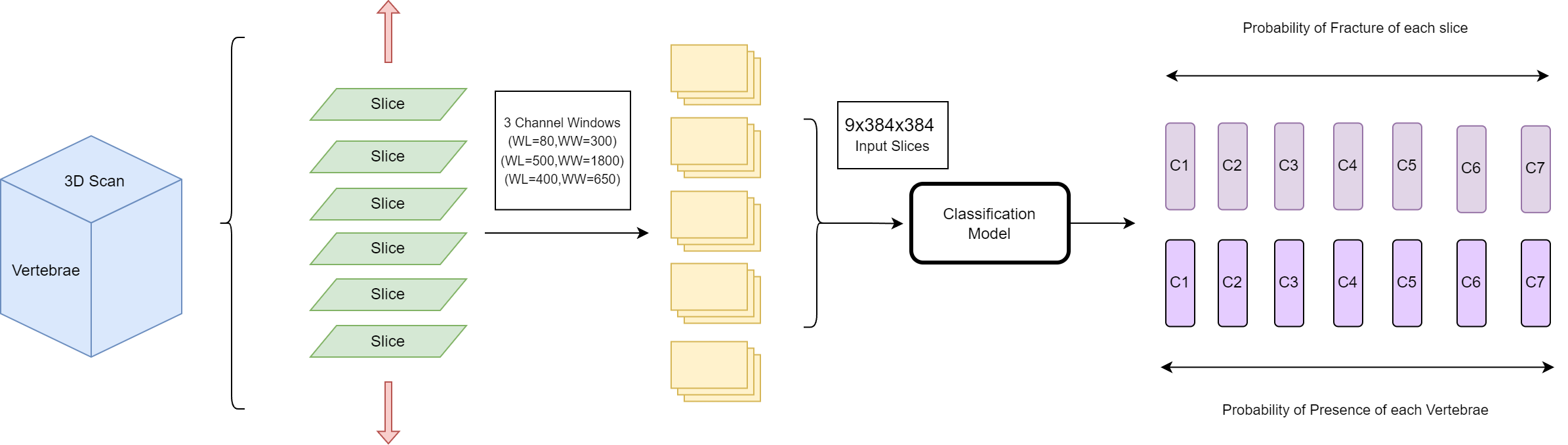\n\nThanks to RSNA and Kaggle for conducting such an exciting competition, and congratulations to all the winners!\n\nIt is a modified version of the pipeline shared by @vslaykovsky in [this](https://www.kaggle.com/competitions/rsna-2022-cervical-spine-fracture-detection/discussion/348462) discussion. \n\n#### CV Strategy \nI use a 5 fold strategy, grouped by StudyInstanceUID and stratified by the fractures in all vertebrae (A column is created concatenating all the fractures like 0_1_0_0_0_1_0 and then used to stratify)\n\n#### Preprocessing\nI use windowing to preprocess the Dicom image used in previous RSNA solutions. The three window values were derived from [this](https://arxiv.org/abs/2010.13336) paper. \n\n```\ndef window(img, WL=50, WW=350):\n upper, lower = WL+WW//2, WL-WW//2\n X = np.clip(img.copy(), lower, upper)\n X = X - np.min(X)\n X = X / np.max(X)\n X = (X*255.0).astype('uint8')\n return X\n\ndef dicom_load(self, siuid, slic):\n path = f\"data/train_images/{siuid}/{slic}.dcm\"\n img = dicom.dcmread(path)\n img.PhotometricInterpretation = 'YBR_FULL'\n data = img.pixel_array\n slope = img[('0028','1053')].value\n intercept = img[('0028','1052')].value\n data = data*slope + intercept\n \n windowed = np.stack((window(data, WL=80, WW=300),\n window(data, WL=500, WW=1800),\n window(data, WL=400, WW=650)\n ), axis=-1)/255.\n return windowed\n ```\n\n#### Training Data\n\nEach 3-Channel slice is concatenated with +1/-1 Neighbour slices to create a 9-channel Input. This 9 Channel input predicts the fracture probabilities and vertebrae presence of the middle slice.\n\nDuring inference, this 3-slice window is shifted by stride 2 for faster Inference.\n\n#### Model\n\nI use `Timm` library to use pretrained models and modify the first layer to take a 9-channel input.\n\n```\nself.model = timm.create_model('tf_efficientnetv2_l', pretrained=True, num_classes=0)\nself.model.conv_stem = nn.Conv2d(9, 32, kernel_size=(3, 3), stride=(2, 2), padding='same', bias=False)\n```\n\n\n### What didn't work\nThis is a huge list, but I will narrow it down to 3 approaches to predict patient_overall ->\n\n- In the above approach, the sequential information between the slices is only used in the +1/-1 concatenation. To leverage more context, I generated embeddings for all the slices and then tried to predict the `patient_overall` using an LSTM/Transformer.\n\nPossible Reason for not working: This Stage2 model had only 2k data points to learn from, which might not have sufficed.\n\n- Uniformly/Randomly select a fixed number of slices from the patient scans and train a 3D Classifier.\n\nPossible Reason for not working: Fractures can only be seen in some slices and specific slices need to filtered out.\n\n- Trained an XGBoost to to predict patient overall from the fracture probabilities of C1-C7 vertebrae.\n\nPossible Reason for not working: Could not beat the prediction performance of `1-np.prod(1-c1c7)` \n\n\n\n\n\n\n\n\n ", "2007673": "Really similar approach and not working list. I also read the paper. Maybe next competition we can go up with learning from gold medal solutions. Thanks for sharing your solution and congratulations for silver medal.", "2011804": "Thanks for sharing! How did you decide on the specific efficientnet model?" } }