
This was my first Kaggle competition and it was a fun ride. Many thanks for the organizers and everyone involved. Special thanks to @jirkaborovec whose public notebooks helped me a lot at the beginning of this competition to kickstart my approach.
\nI used a simple tile-based approach where I trained a ConvNeXt_Tiny model to classify each tile as one of the 5 categories:
\nUsing the supplemental masks, I trained an EfficientNet_B0 (pretrained) model with similar training parameters as the main model to detect tiles with tumor (0.97 CV5 balanced accuracy). As training data, I selected tiles with tumor label > 95% for the tumor class and tiles with stroma+necrosis label > 50% and tumor label < 5% for the no-tumor class.
\nI cut each WSI into 1024x1024 px tiles (dropping tiles with > 60 % black background) and used 32 random tumor tiles (based on the EfficientNet_B0 model with 0.5 threshold) from each image for both training and inference. Predictions were averaged between tiles during inference.
\nOne 2048x2048 px (to compensate for the x2 magnification) tile was cut from the center of the image.
\nUsing a sigmoid activation function, an image was marked as Other if the largest activation was smaller than 0.8.
\n
(As an extra: some accidental augmented images with questionable artistic value.)
", "messages": [ { "id": 2587647, "postDate": "2024-01-04T23:02:38.303Z", "content": "This was my first Kaggle competition and it was a fun ride. Many thanks for the organizers and everyone involved. Special thanks to @jirkaborovec whose public notebooks helped me a lot at the beginning of this competition to kickstart my approach.
\nI used a simple tile-based approach where I trained a ConvNeXt_Tiny model to classify each tile as one of the 5 categories:
\nUsing the supplemental masks, I trained an EfficientNet_B0 (pretrained) model with similar training parameters as the main model to detect tiles with tumor (0.97 CV5 balanced accuracy). As training data, I selected tiles with tumor label > 95% for the tumor class and tiles with stroma+necrosis label > 50% and tumor label < 5% for the no-tumor class.
\nI cut each WSI into 1024x1024 px tiles (dropping tiles with > 60 % black background) and used 32 random tumor tiles (based on the EfficientNet_B0 model with 0.5 threshold) from each image for both training and inference. Predictions were averaged between tiles during inference.
\nOne 2048x2048 px (to compensate for the x2 magnification) tile was cut from the center of the image.
\nUsing a sigmoid activation function, an image was marked as Other if the largest activation was smaller than 0.8.
\n
(As an extra: some accidental augmented images with questionable artistic value.)
", "rawMarkdown": "This was my first Kaggle competition and it was a fun ride. Many thanks for the organizers and everyone involved. Special thanks to @jirkaborovec whose public notebooks helped me a lot at the beginning of this competition to kickstart my approach. \n\n# Best model\nI used a simple tile-based approach where I trained a ConvNeXt_Tiny model to classify each tile as one of the 5 categories:\n- ConvNeXt_Tiny, pretrained\n- 512x512 px image size\n- batch size: 32\n- random horizontal/vertical flip augmentation\n- color augmentation (brightness, contrast, saturation, hue)\n- color normalization\n- Cross-Entropy Loss\n- AdamW optimizer, StepLR (step_size=2, gamma=0.1), LR=1e-4\n- 1 + 5 epochs (convolutional layers feezed for the initial epoch)\n- CV5, Stratified Group KFold\n\n# WSI tiling\nUsing the supplemental masks, I trained an EfficientNet_B0 (pretrained) model with similar training parameters as the main model to detect tiles with tumor (0.97 CV5 balanced accuracy). As training data, I selected tiles with tumor label > 95% for the tumor class and tiles with stroma+necrosis label > 50% and tumor label < 5% for the no-tumor class.\n\nI cut each WSI into 1024x1024 px tiles (dropping tiles with > 60 % black background) and used 32 random tumor tiles (based on the EfficientNet_B0 model with 0.5 threshold) from each image for both training and inference. Predictions were averaged between tiles during inference.\n\n# TMA “tiling”\nOne 2048x2048 px (to compensate for the x2 magnification) tile was cut from the center of the image.\n\n# Other class\nUsing a sigmoid activation function, an image was marked as Other if the largest activation was smaller than 0.8.\n\n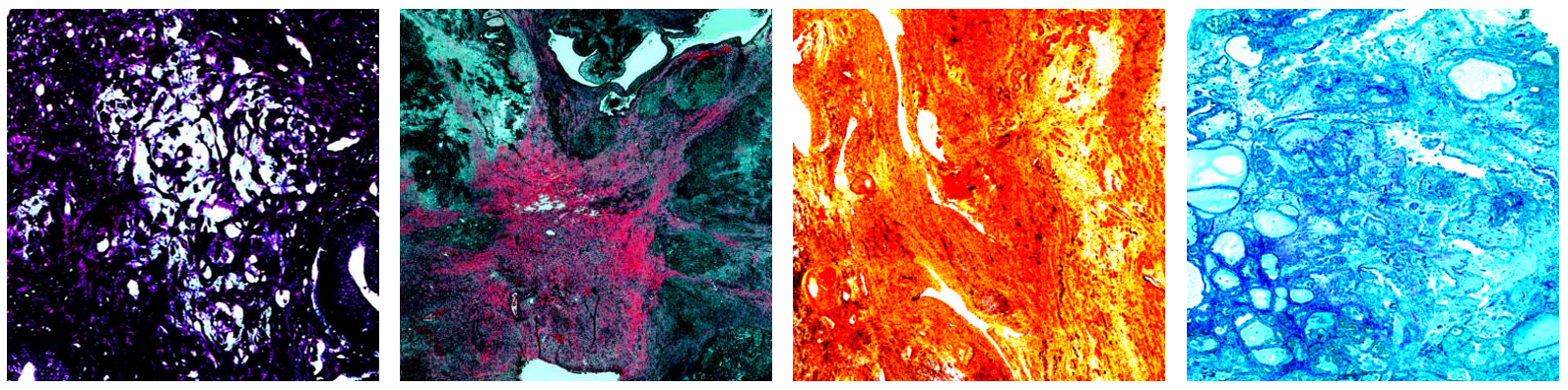\n\n(As an extra: some accidental augmented images with questionable artistic value.)\n", "votes": 8 } ], "comments": [], "raw_markdown_by_id": { "2587647": "This was my first Kaggle competition and it was a fun ride. Many thanks for the organizers and everyone involved. Special thanks to @jirkaborovec whose public notebooks helped me a lot at the beginning of this competition to kickstart my approach. \n\n# Best model\nI used a simple tile-based approach where I trained a ConvNeXt_Tiny model to classify each tile as one of the 5 categories:\n- ConvNeXt_Tiny, pretrained\n- 512x512 px image size\n- batch size: 32\n- random horizontal/vertical flip augmentation\n- color augmentation (brightness, contrast, saturation, hue)\n- color normalization\n- Cross-Entropy Loss\n- AdamW optimizer, StepLR (step_size=2, gamma=0.1), LR=1e-4\n- 1 + 5 epochs (convolutional layers feezed for the initial epoch)\n- CV5, Stratified Group KFold\n\n# WSI tiling\nUsing the supplemental masks, I trained an EfficientNet_B0 (pretrained) model with similar training parameters as the main model to detect tiles with tumor (0.97 CV5 balanced accuracy). As training data, I selected tiles with tumor label > 95% for the tumor class and tiles with stroma+necrosis label > 50% and tumor label < 5% for the no-tumor class.\n\nI cut each WSI into 1024x1024 px tiles (dropping tiles with > 60 % black background) and used 32 random tumor tiles (based on the EfficientNet_B0 model with 0.5 threshold) from each image for both training and inference. Predictions were averaged between tiles during inference.\n\n# TMA “tiling”\nOne 2048x2048 px (to compensate for the x2 magnification) tile was cut from the center of the image.\n\n# Other class\nUsing a sigmoid activation function, an image was marked as Other if the largest activation was smaller than 0.8.\n\n\n\n(As an extra: some accidental augmented images with questionable artistic value.)\n" } }